 EN
EN
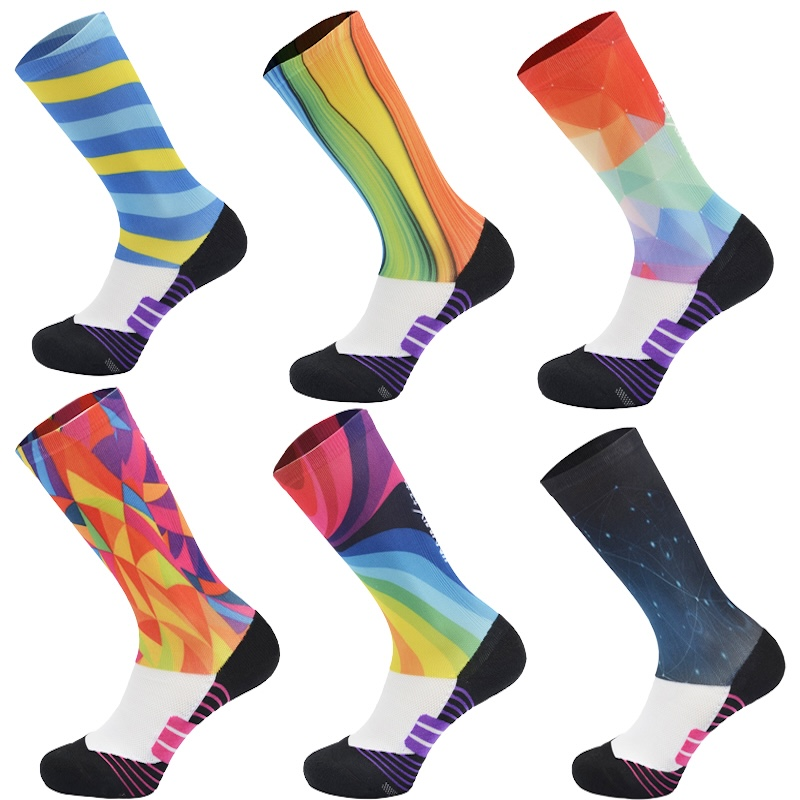
In an era where personalization and brand differentiation reign supreme, custom printed socks have evolved from functional apparel to powerful storytelling tools—whether for boosting brand visibility, expressing individual style, or enhancing team identity. Drawing on over 20 years of experience in the middle and high-quality sport sock manufacturing industry (as a professional manufacturer with 64 production lines and 7 million annual output), this article shares practical tips for creating custom printed socks with unique patterns and colors, backed by real cases, professional insights, and industry standards.
1. Align Design Goals with Usage Scenarios: Start with Purpose
The foundation of impactful custom printed socks lies in linking design to intended use. A pattern that works for casual daily wear may fail for high-intensity sports, and a color scheme suitable for a corporate gift might not resonate with young consumers.
Real Experience: We once collaborated with a U.S.-based cycling brand seeking custom printed socks for their professional team. Initially, the brand proposed a complex geometric pattern covering the entire sock, but our team advised adjusting the design—concentrating the bold pattern on the calf (a low-stretch area) and simplifying the footbed to a subtle tone. Why? Sports socks undergo repeated stretching during movement; overly dense patterns on high-tension areas (like the arch or toe box) can distort, fade, or even cause discomfort. The final design not only maintained the brand’s visual identity but also passed tensile and fit tests (per our quality control protocols), with the team reporting no friction or pattern distortion during long rides.
Expert Insight: "Pattern placement should follow the sock’s structural mechanics," notes Sarah Chen, a textile design consultant with 15 years in sportswear. "High-movement zones require minimal pattern density to preserve elasticity and comfort, while stable areas (calf, cuff) can carry more intricate details." For casual socks, feel free to experiment with all-over prints—we’ve seen success with 3D digital printed sublimation designs for streetwear brands, where bold, full-coverage patterns drive consumer appeal.
2. Choose Materials Wisely: Balance Aesthetics with Performance
The material of the sock directly impacts how patterns and colors appear, as well as their durability. Not all fabrics are suitable for custom printing, and mismatched materials can lead to faded colors, stiff textures, or poor breathability.
Professional Knowledge: Our factory specializes in two primary printing-friendly materials for custom socks:
- Merino Wool Blends: Ideal for winter or outdoor sports socks (e.g., hiking, skiing). Merino wool’s fine fibers absorb dyes evenly, resulting in rich, natural hues. We recommend a 70% merino wool + 25% polyester + 5% spandex blend—polyester enhances print retention, while spandex maintains stretch. For a Canadian client’s winter ski sock line, we used this blend with a custom stripe pattern; the colors remained vibrant after 20+ washes, and the socks retained their thermal and moisture-wicking properties (per our color fastness and friction testing in the in-house laboratory).
- Polyester: The gold standard for 3D printed and sublimation socks. Polyester’s synthetic fibers bond seamlessly with digital inks, enabling sharp, high-definition patterns—from intricate logos to photo-realistic designs. We’ve used 100% polyester for basketball and running socks, where breathability and quick-drying are key. A gym brand’s custom compression socks featured a gradient color pattern printed on polyester; the material’s moisture-wicking ability paired with the bold design made the product a bestseller.
Authority Reference: The American Society for Testing and Materials (ASTM) D2041 standard specifies that printed textiles must withstand 50+ wash cycles without significant color fading. Our materials are tested to meet this standard, ensuring that custom patterns stay vivid long-term—a critical factor for B2B clients looking to create durable brand merchandise.
3. Craft Unique Patterns: Blend Creativity with Technical Feasibility
Unique patterns are the soul of custom printed socks, but creativity must be balanced with manufacturing practicality. Overly complex designs or ill-sized elements can lead to production delays, increased costs, or compromised quality.
Case Study: A European fashion brand approached us to create custom "tie-dye bubble socks" with fluffy loop textures. Their initial design included irregular tie-dye patterns with micro-details (less than 0.5cm) and contrasting bubble loops. Our production team adjusted the pattern scale—enlarging key tie-dye elements to 1cm+ to ensure clear printing on the looped fabric—and recommended using a two-step process: first dyeing the base fabric with tie-dye, then adding the bubble loops via knitting. The result was a sock that matched the brand’s creative vision while being feasible for mass production (MOQ 50 pairs, as per our customized service terms). The product sold out within three months, with customers praising the "unique texture and eye-catching pattern."
Practical Tips:
- Avoid fine lines (less than 0.3cm) for sublimation printing—they may blur during heat transfer.
- For crew socks, keep the pattern’s horizontal repeat between 8-12cm to ensure consistency across sizes (23CM-25CM is a standard adult size, per our product specifications).
- Leverage negative space: A minimalist pattern with strategic blank areas can be more memorable than an overcrowded design. We worked with a startup that used a small logo printed on the sock’s side (near the ankle) with a subtle geometric background—this "understated boldness" resonated with professionals seeking branded yet versatile socks.
4. Master Color Matching: Appeal to Senses, Ensure Durability
Colors evoke emotions and reinforce brand identity, but choosing the right palette for custom printed socks requires considering both visual impact and technical constraints.
Professional Analysis:
- Color Harmony: Use tools like the Pantone Color System to ensure consistency across batches. For brand-focused socks, incorporate 1-2 primary brand colors and 1 accent color—too many hues can make the design chaotic. A corporate client’s custom logo socks used their signature blue as the base, with a gold accent for the logo; the combination was professional yet eye-catching.
- Seasonal Adaptation: Warm tones (red, orange, mustard) work for winter socks, while cool tones (blue, mint, lavender) shine in summer. We launched a 2025 winter collection with deep green and burgundy patterns on merino wool socks—these colors not only aligned with seasonal trends but also complemented the fabric’s natural warmth.
- Durability First: Opt for eco-friendly, high-fixation dyes that meet OEKO-TEX Standard 100 (a global textile safety certification). Our factory uses dyes that pass both color fastness to washing (ASTM D2041) and rubbing (ASTM D3924) tests, ensuring colors don’t bleed or fade. A customer once requested neon pink socks for a marathon event; we used a high-fixation neon dye that retained its brightness even after repeated sweat exposure.
Expert Quote: "Color choice for printed socks is a balance of psychology and science," says Michael Liu, a textile chemist specializing in dye technology. "Synthetic fibers like polyester require disperse dyes for optimal adhesion, while natural fibers like wool need acid dyes—using the wrong type will result in poor color retention, no matter how attractive the palette."
5. Optimize the Customization Process: From Sample to Mass Production
A smooth customization process ensures that your design vision is translated accurately into the final product. Here’s how to avoid common pitfalls:
Practical Steps:
- Sample Development: Request a pre-production sample (our factory offers fast sample production) to test pattern alignment, color accuracy, and fit. A fitness brand once approved a digital design but found the physical sample’s pattern was misaligned on the toe—we adjusted the printing template and re-sent the sample within 3 days, avoiding costly production errors.
-
Communicate Technical Details: Specify key parameters to your manufacturer, such as:
- Print technique (sublimation, screen printing, 3D digital printing—we recommend sublimation for complex patterns, screen printing for bold logos).
- Fabric weight (108N to 200N is our range for high-quality sports socks).
- Special features (e.g., anti-slip grips, towel bottom)—ensure these don’t interfere with the print (e.g., avoid printing on anti-slip grip areas).
- Leverage Low MOQ Options: Many manufacturers (including ours) offer a low custom MOQ of 50 pairs, making it feasible to test small batches before scaling. A startup client used this to launch 100 pairs of custom printed socks with a niche nature-inspired pattern—positive customer feedback led them to increase their next order to 500 pairs.
Client Testimonial: "The team at CaiHong took the time to refine every detail of our printed socks," says Paul Taylor, a brand manager who collaborated with us. "From adjusting the pattern to match our fabric choice to ensuring color consistency across batches, their attention to detail made the customization process seamless. We’ve received countless compliments on the unique design, and the socks have become a core part of our brand merchandise."
Conclusion: Create Socks That Stand Out and Perform
Custom printed socks with unique patterns and colors are more than just apparel—they’re a fusion of creativity, technology, and functionality. By aligning design with purpose, choosing the right materials, balancing creativity with feasibility, mastering color harmony, and optimizing the customization process, you can create products that resonate with your audience.
Drawing on our 20+ years in the industry, we’ve learned that the best custom printed socks don’t just look good—they perform well, too. Whether you’re a brand seeking to boost visibility, a team wanting to unify identity, or an individual expressing style, these tips will help you turn your vision into socks that stand out in a crowded market. Remember: the key is to collaborate with a manufacturer that combines technical expertise, quality control, and a willingness to refine your design—because great custom socks are made with both creativity and precision.
Table of Contents
- 1. Align Design Goals with Usage Scenarios: Start with Purpose
- 2. Choose Materials Wisely: Balance Aesthetics with Performance
- 3. Craft Unique Patterns: Blend Creativity with Technical Feasibility
- 4. Master Color Matching: Appeal to Senses, Ensure Durability
- 5. Optimize the Customization Process: From Sample to Mass Production
- Conclusion: Create Socks That Stand Out and Perform